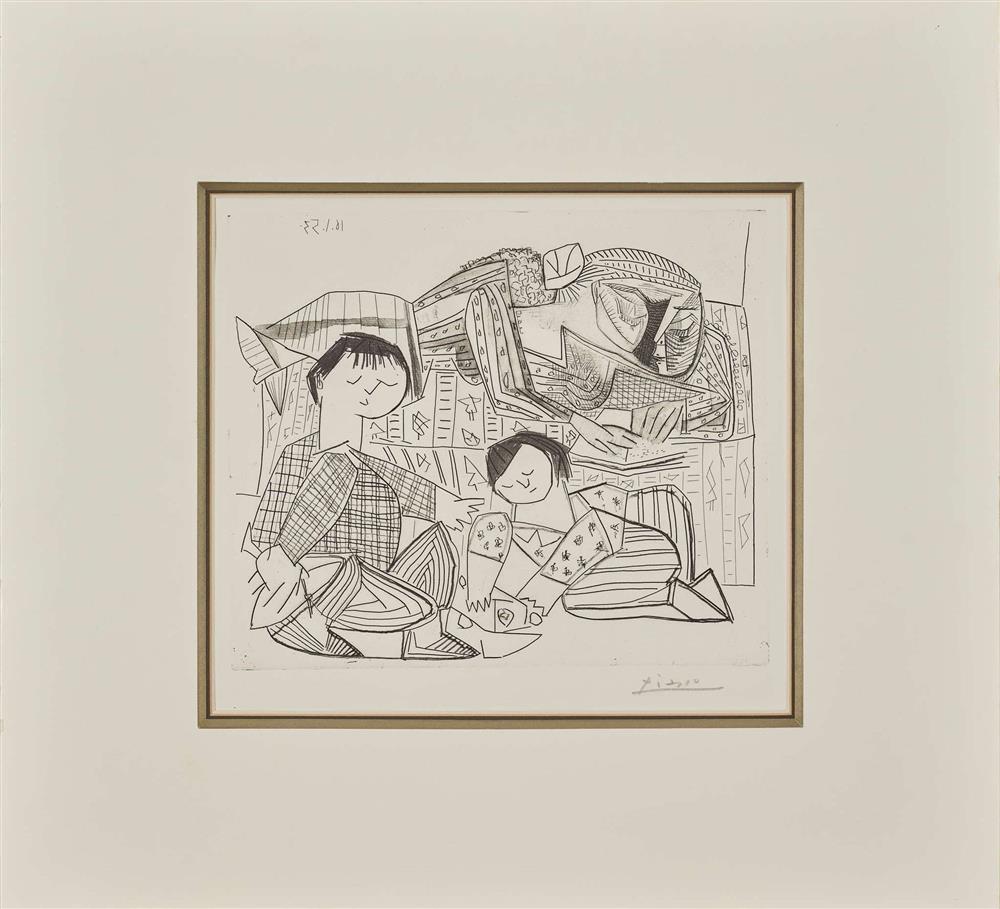
Pablo Picasso – Mere et Enfants
Limited Edition by Masters
POA
Available
- Edition: 50
- Framed size: 33 x 39 x 5 cm
- Image size: 25 x 31 x 5 cm
Arrange a Viewing
Pablo Picasso - Mere et Enfants by Masters
Background
Pablo Picasso frequently explored the theme of mother and child throughout his career, depicting the bond between them with evolving styles and emotional depth. This subject was prominent during his Blue Period (1901–1904) and Rose Period (1904–1906) but remained a recurring motif in his later works as well.
As he moved into Cubism (post 1907) he continued to explore the mother-and-child theme but with greater abstraction. This etching is a superlative example of that abstraction with Picasso using geometric shapes to represent the figures of the mother and two children. In the 1960s, particularly after becoming a father (of Claude and Paloma), his portrayals of motherhood became even more expressive and personal, as seen in his drawings of his own children with their mother.
For Picasso, the mother-and-child motif was not just about maternal love but also about human vulnerability, protection, and the universal cycle of life. His works often reflected a deep sense of attachment and affection, with his intimate and personal connection to the subject matter expressed through powerful forms and strong lines, to capture the depth of maternal love and connection.
Biography
Pablo Picasso (1881–1973) was a Spanish artist widely regarded as one of the most influential figures in modern art and art history as we know it. Known for his ability to constantly reinvent his style, Picasso played a key role in shaping the 20th century’s artistic landscape. He co-founded Cubism with Georges Braque, creating iconic works like Les Demoiselles d’Avignon (1907) and Guernica (1937).
Picasso’s career spanned many periods, from the somber Blue Period (1901–1904) to the light and playful Rose Period (1904–1906), and he later experimented with Surrealism and Neoclassicism. Throughout his life, Picasso was continuously innovative, working across mediums like painting, sculpture, printmaking and ceramics.
Printmaking was a significant part of his career, and he created a vast and varied body of prints, including etchings, lithographs, linocuts, and woodcuts.
Printmaking allowed Picasso to experiment with new techniques and ideas, often in a more accessible and spontaneous way than with paintings or sculptures. He used printmaking as a means to push his creativity, exploring abstraction, symbolism, and form.